Posts Tagged ‘Jews’

WW2 Anniversary

|   24 March 2012

Foreigners to Auschwitz

Auschwitz

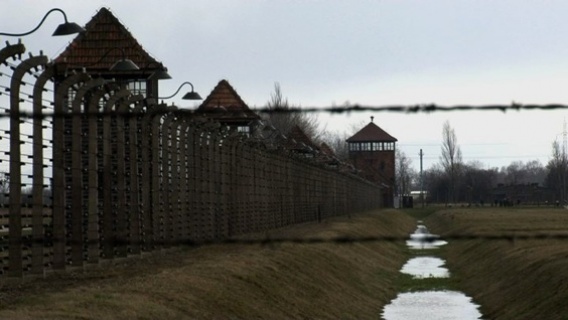
Seventy years ago this week an event of enormous significance took place. The first Jews from outside Poland were deported to Auschwitz.

It’s significant not just because these Jews were from another European country – the first of many – but because of the deal under which they were sent. It was a shocking arrangement – one which reminds us that the Holocaust was far more than a solely ‘German’ crime.

These Jews came from the neighbouring country of Slovakia, and were only deported to Auschwitz after high level meetings between the Germans and the Slovaks the previous month. In February 1942 the Prime Minister of Slovakia, Vojtech Tuka had met with Major Dieter Wisliceny of the SS. After further reflection in Berlin, a deal was finally done whereby the Slovaks agreed to pay the Germans 500 Reichsmarks for every Jew deported. But on condition that the Germans guaranteed that these Jews would ‘never come back’. That way the Slovaks knew that they could steal the property of the Jews with impunity.

Silvia Vesela, then a young Jewish women, remembers how non-Jewish Slovaks turned on her. ‘I thought about it several times,’ she says. ‘Human material is very bendable. You can do anything with it. When money and life are involved, you seldom meet a person that is willing to sacrifice for you. It hurt, it really hurt when I, for example, saw my schoolmate shouting with her fist raised, ‘It serves you right!’ Since that time I do not expect anything of people.’

Silvia Vesela was transported with thousands of other Slovak Jews to Auschwitz 70 years ago.

Today, as well as their suffering, let’s also remember the negotiations which sent them there. And a deal which meant that a European state, Slovakia, ‘paid’ to have its Jews taken away.

WW2 Relevance

|   25 January 2011

Victims and Perpetrators

Tallinn, Estonia

I just spent a few days in Tallinn, capital of Estonia and was intrigued by the somewhat dodgy way they seem to remember their WW2 history.

The central message of the Museum of Occupation in Tallinn is clear – the Estonians were victims during the war. And to a large extent, that’s correct. Estonia, along with the other Baltic states, had been granted independence as part of the peace settlement at the end of the First World War – an independence which was subsequently sabotaged by the Molotov/Ribbentrop pact.

Stalin insisted first on stationing Red Army troops in Estonia and then, in the summer of 1940, on a full scale occupation of the country. Hundreds of thousands of Estonians suffered under Soviet rule and so, perhaps not surprisingly, many Estonians welcomed the Nazis when they arrived in Estonia as part of their invasion of the Soviet Union in the summer of 1941.

Then, once the Red Army returned in 1944, the Soviet oppression restarted. Estonian culture was suppressed, thousands were deported to Siberia and imprisonment and torture were commonplace. The Soviet authorities also made a concerted effort to settle ethnic Russians in Estonia in an attempt to submerge nationalist feelings – using a similar tactic to the one currently practiced by the Chinese in Tibet.

Not until after the fall of the Berlin were Estonians finally granted their freedom. The country now is a proud member of the EU and NATO, and on 1 January this year joined the Euro. You get the feeling that the Estonians will do virtually anything to weld themselves to Western Europe – a policy that’s easy to understand given the history of the country and the looming presence of the Russian giant at their Eastern border.

Which is all fine as far as it goes. But the trouble is that there is a gigantic omission from this history – which is the story of how Jews in Estonia were treated. There were around 1,000 Jews left in Estonia when the Nazis arrived and virtually all of them were subsequently murdered – and Estonian collaborators helped the Nazis commit the crime. Estonians also helped the Nazis run concentration camps on Estonian soil.

Read the rest of this entry

WW2 Anniversary

|   22 July 2010

The Nazis and the Madagascar Plan

The Nazis had a plan to send the Jews here, to Madagascar.

This month marks the 70th anniversary of one of the most bizarre and potentially murderous Nazi ideas of them all – a plan to forcibly deport European Jews to the island of Madagascar off the coast of Africa. It isn’t an event of 1940 – like the Fall of France, Dunkirk or the Battle of Britain – that you’ll see mentioned in the newspapers or on the TV news, but it’s certainly worth remembering all the same.

On 3 July 1940, Franz Rademacher of the German Foreign Ministry wrote a memo which suggested that ‘France must make the island of Madagascar available for the solution of the Jewish question’. The idea was that the Jews of Europe should be sent to live on Madagascar, supervised by an ‘SS Governor’. And this was clearly not some kind of relatively ‘benign’ way of ’solving’ the ‘Jewish question’. The presence of the SS Governor clearly shows how the Jews were to be treated, and the alacrity with which Reinhard Heydrich – a crucial figure in the eventual ‘Final Solution’ – subsequently muscled in on Rademacher’s plan further demonstrates the murderous intent behind it.  This plan might have involved a different route to genocide than the gas chambers of the Holocaust, but it was still a route to genocide all the same.

The decision of the British not to make peace with the Germans in 1940 consigned the Madagascar plan to the dustbin – how could the mass sea transportation of the Jews be organized whilst the war was still being fought? But the Madagascar plan remains important for at least two reasons. The first is that it shows the limitless sense the Nazis possessed that they could accomplish anything. Yes, others (including the Polish government just before the war) had fantasised that Madagascar could be a place that European Jews could settle, but no one except the Nazis had imagined forcibly pushing the policy through on this scale and with this genocidal intent.

The Madagascar plan thus fitted into a Nazi pattern of thought. For one emotion that characterized many of the former Nazis I’ve met over the years was the immense and liberating sense of excitement they felt about belonging to the Nazi party. ‘It was a time when dreams could become a reality!’ one of them told me.

And the second reason that the Madagascar plan is important is that it demonstrates that the Nazis would have carried on trying to eliminate the Jews even if they had won the war and the world was subsequently at peace. In that respect I certainly agree with those historians who no longer see September 1939 as some sudden moment of violent radicalization in Nazi anti-Semitic policy, but instead point to the pogrom against the Jews in November 1938 – the so-called Kristallnacht – as showing that the Nazis were some way along a murderous road before the invasion of Poland. And the mere ending of the war would not have assuaged their blood lust.